Third
Person in simple present: Final -s pronunciation
The conjugation of the verbs for he-she-it has a lot of extra requirements, right?! If you noticed, one particularity is that, in present simple, there are different posibilities when verbs are conjugated with those subjects (third person singular) and acquire an extra -s, -es or -ies at the end.
When pronuncing the final -s sound in the previous cases, we have three options. Here we have general rules for this topic.
Start at 1:01
After those general principles, you may want to know what are the specific sounds with vibration that make the final -s sound like a Z; the sounds without vibrationthat make the final -s sound like a S; as well as the repeated sounds that make the final -s sound like a IZ.
Lets practice. Here you have some games to check if you got these pronunciation rules.
Practice.
Part 1. Choose one of these comics. Describe the actions of the
story in simple present tense and with he, she or it. Send a recordingto the group of you
reading the comic.
For example: Jimmy always forgets (/s) his lunch. He remembers (/z/) at the bus stop.
Part 2. Choose one of these videos and watch it. Describe what happens in the
story by using he-she-it in simple present tense. Send a recording of you reading your summary/sentences.
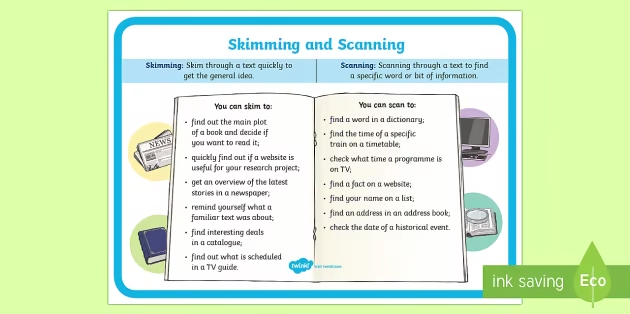
How do we extract key information from a text? When we have a reading or a video, we may need to obtain specific information in a simple, quick manner. Sometimes we need to analyze a long portion of a text or its entirety. Howeverver, let's start by the beginning: the cases when we need specific information contained in the text. Two of the most popular techniques are skimming & scanning, and they are also highly effective in standarized English-language testing. Firstly, why is it important to have a comprehensive reading?
In brief, people can learn from texts if they know how to analyze. At the same time, they need to organize in their heads the abstract information contained in the explicit and implicit text.
Moreover, there are general tips we can apply to start. After we become experienced, we can decide which one works best for each comprehension task.
After we digest a little of these principles, we can dive into the techniques we have for today.
These simple tips apply to a lot of situations so keep them in mind.
Let's practice 1. Play these games to test if you got the general concepts.
Let's practice 2. Here you have some texts and questions to answer. In a lot of cases, the text and questions include synonyms or some different word order. That is a way to increase a little the difficulty of the exercise, so take into account that you don't always have to look for an exact word or phrase from the question.
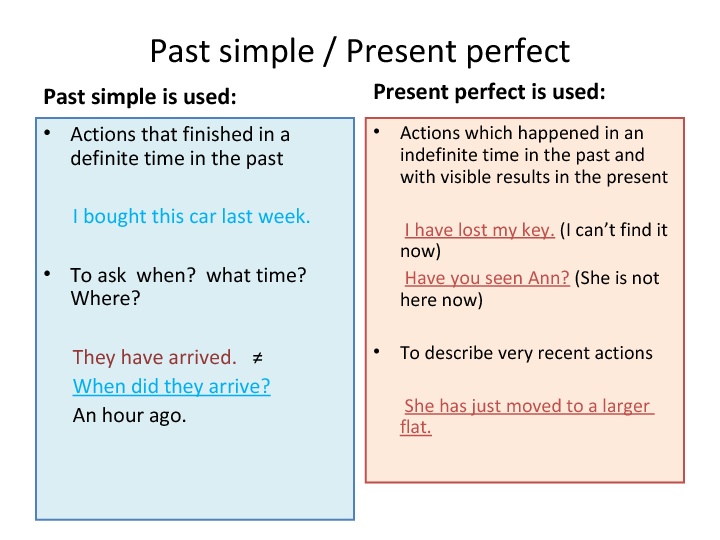
We can tell actions that ocurred in the past and we don't want to specify the moment, or that they began in the past and continue in the present (moment of speaking). That is called present perfect. The following is an example of how to use it in real situations. Pay attention that the verbs are not in simple past form.
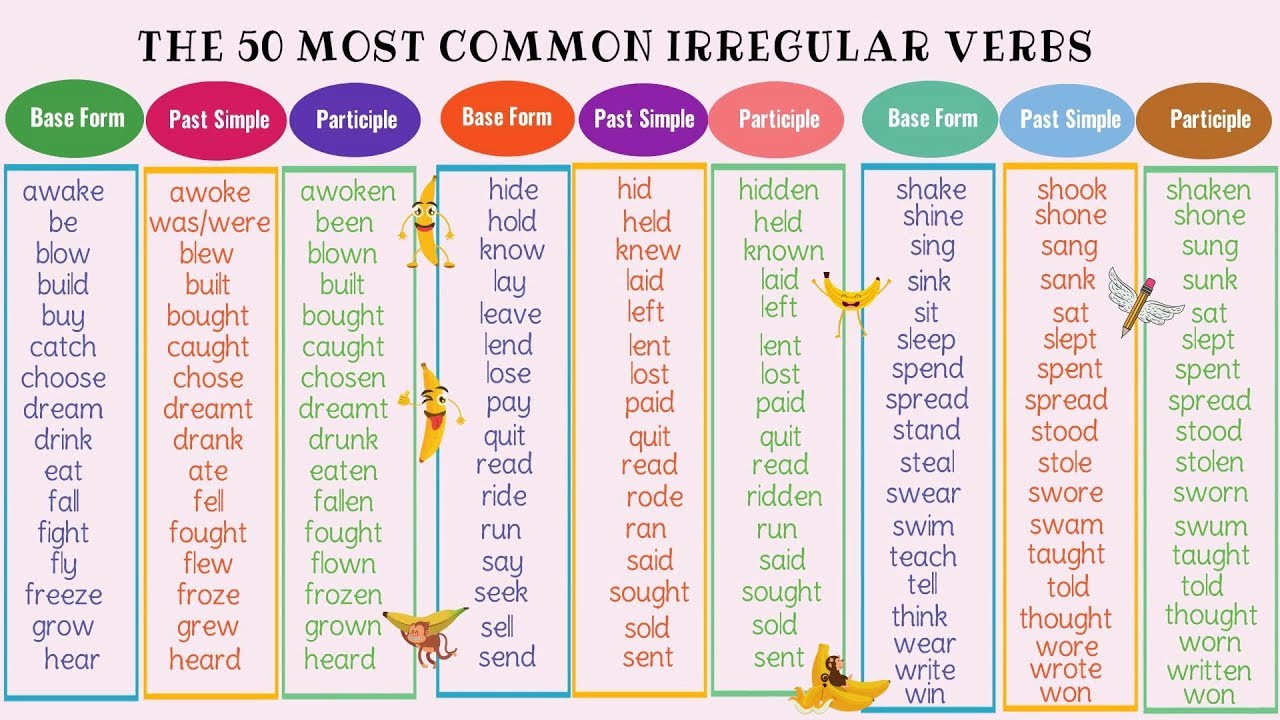
We have regular verbs which only need to have -ed after the base form of the verb, but we also have a lot of cases we must memorize. Here we have two options for learning common verbs. It's better if you learn the three forms of the same verb + the meaning. For today, we are using the past participle form.
Let's practice 1. Play with this game; choose the correct verb and then its correct past participle form.
All these verbs are commonly used in the present perfect tense. Let's check that topic so you can practice the regular and irregular verbs in past participle in different situations. Present perfect: Grammar Present perfect: When to use
Let's practice 2. In the next games you have to choose between simple past and past participle forms. Watch this video first to refresh the functions of each tense so you can complete the game correctly.
Final practice. Choose a common situation and send an audio to the WA group. The topic must be an every-day life situation like your personal information, work experience, traveling experience, etc. Tell your story about that topic with minimum 10 irregular verbs in past participle verbs, and 5 irregular verbs in simple past. Also use both simple past and present perfect in the correct situation. For instance: I have lived in Costa Rica for 10 years. I moved with my family in 2012. We have bought a lot of plants for our house; those plants have grown so nice that I'm amazed.
Pronunciation of regular verbs in past simple (ending in -ed)
To mention in English past actions that finished, we haveirregular verbsand regular verbs. The second group is easier to study since they only need to receive "-ed" at the end. Maybe you have noticed that the -ed at the end of verbs doesn't keep the same pronunciation. For instance. The -ed at the end of "worked" is different from the -ed at the end of "lived" or "voted."
Listen to the story in Kung Fu Panda. Even if it's in past, do the verbs ending in -ed have the same pronunciation at the "-ed" final section?
Don't worry. Native English speakers also have issues with this pronunciation. That's why they have principles to eliminate or reduce the pronunciation of the last -d or -t sounds.
Watch from 1:30 to 6:20
Watch from 0:20 to 2:21
Let's practice.Part 2.
Create
a little explanation of the 2 situations where you can eliminate the -t or -d at the end of words. Make an infographic or power point presentation to show to your classmates & teacher. This is the original video.
Use paint, canva.com, genial.ly or another software to create the graphic (include rules, points that you pay
attention to and pictures) and give examples.
This pronunciation principles apply to simple past and past participle forms. It means that this topic is useful in different tenses like simple past and perfect present.
Final practice.
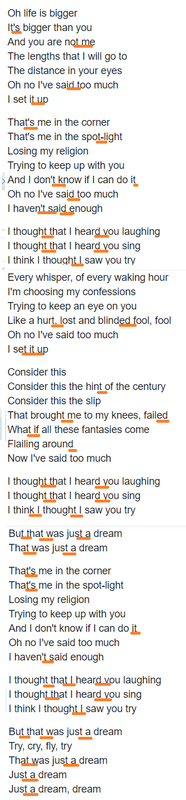
Part 1. Read the lyrics of Losing My Religion. Record an audio so you can check if you are pronouncing correcly the final sounds -t, d-, -ed. Send it when you believe you got the correct pronunciation. Please listen to the song so you get an idea of a natural pronunciation.
Part 2.Record an audio telling the story of what you did last month. Use simple past. Use also past participle in the story only if we studied that previously. Try to use only regular verbs (minimum 10 ending in -ed) and the correct pronunciation according to today's content. You can use alsoirregular verbs if your story needs them.
Do you want to develop confidence so you can use all the grammar, vocabulary and other resources you have studied about a second language like English?
Source: Own elaboration
Here are some tips to get over your fear of speaking in a second language.
Source: Adapted from Clark, 2020
Let's do some practice. Choose one object you know and like. It can be anything. Describe it using all the vocabulary and grammar you can. Use ALL the sentences you can... Just keep talking.
In your free time and while practicing with classmates, use these materials during all your learning process. The manner and frequency depends on our individual capabilities, so think and choose how to use them.
Source: Adapted from Dodds, 2021
Activity 3. Combining grammar and speaking practice.
Follow the same instruction of playing the game and then telling your opinion or personal information by using the same grammar or vocabulary.
Activity 4: Summary from Ted Talk.Listen to this oral presentation. Analyze it and comment it by using the same & differente grammar/vocabulary. Mention parts that you believe are important and not important/ new concepts for you / points where you agree or disagree. Record an audio or video with your answer and sent it to your teacher and classmates' group.
Source: Own elaboration
References
(2017). 7 Ways to Conquer Your Fear of
Speaking English and Communicate with Courage. RealLife English.
https://reallifeglobal.com/conquerfear/
Clark, G. (2020, 20 april). Afraid of
speaking English? Read this! Clark and Miller.
https://www.clarkandmiller.com/afraid-of-speaking-english/
Dodds, E. (2021). Speak Up! How to Improve
Your Confidence in English. Leonardo English.
https://www.leonardoenglish.com/blog/how-to-improve-your-confidence-in-english#toc-2
During every personal development phase, motivation and real preparation is always needed. Sometimes, it comes by own experience, but other times, books like Who Moved My Cheese are a helpful tool for everyone.
From beginning to end, this book teaches about every day changes and difficulties, and how to reach our goals. Story is a metaphor, made for you to adapt it to your life and understand what you really want and how to get it. I recommend everyone to read it, you will learn and think about future, yours and your family's. What I learned is the importance of every life stage and actions (decisions) that a person do. When obstacles make us to deal with our own weaknesses or pride, if we want to keep searching for success, strange will come out, because human being is able to make changes and overcome issues and to her or him self. Good decisions and a clearly defined path are clues to happiness.
Some conclusions that you can find in the text: “If You Do Not Change, You Become Extinct.” (46) “What Would You Do If You Were Not Afraid?” (48) Anticipate Change (Get ready for the cheese to move) http://sagecoveredhills.blogspot.com/2008/07/who-moved-my-cheese-book-review.html
How to choose the healthy life and the right food?
That is a good question, and I have some clues.
There are cases of people who have healthy behaviors, so they live 100 years or more, but there are other cases where people smoke and don't do exercise, but aspects such as the place where they live (not in city), to don't be stress out or genetic could be the secret. However, if we want to make sure that we may live well and much, the compromise with yourself and your family must be present to do the right. Don't eat fast food (junk food): you can find food pyramids on internet, or consult a professional in nutrition about how your diet should be like. Too much fat and modified products (meat of McDonald's, for example) will insert cholesterol or chemical sustances in your body. Reduce stress: free time must be for relaxing and to do something you enjoy. Exercising regularly: do safely what you enjoy and maintaining an active life style. Keep you hydrated: around eight glasses of water are necessary to have healthy systems, to have energy, a nice skin and a good appearance.
In short, serious information will help you in your choice. Go to the doctor regularly, and the more important: think what you want for your life and the people around you.